
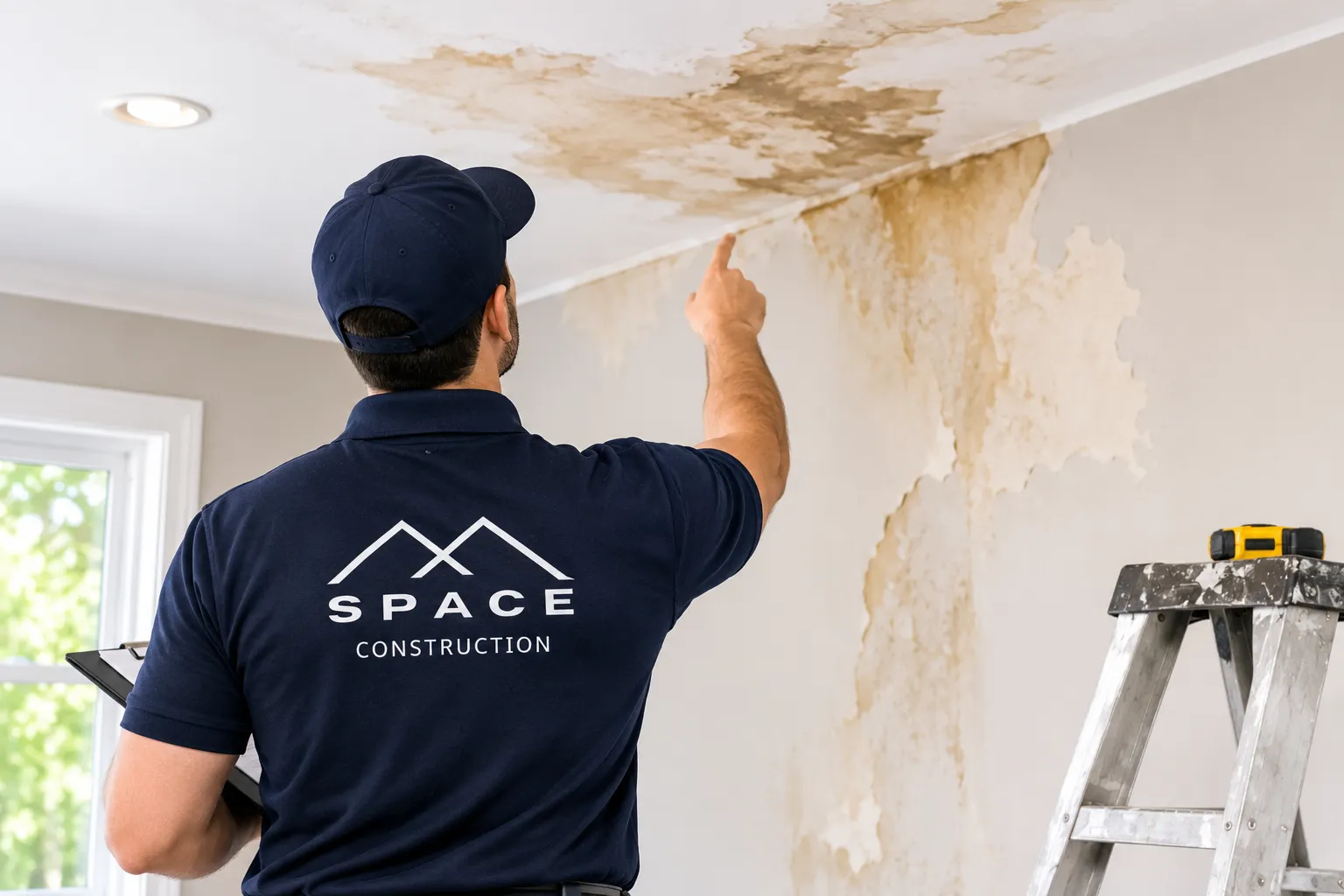
At Space Construction, a good share of our restoration calls begin the same way. A homeowner in Flower Mound or a nearby town notices a faint stain on the ceiling and hopes it will dry out on its own. Sometimes it does. Often, the stain is only the part of the story you can see.
The short answer: Drywall that got briefly wet with clean water, and is still firm and intact, can often be dried and repaired. Drywall that stayed wet, feels soft, sags, or was soaked by dirty water usually has to come out. Costs rise with the size of the area, what’s hiding behind the wall, and whether the source of the leak has been fixed.
Signs Your Drywall Has Water Damage
Water damage rarely announces itself loudly. Watch for these:
- Stains that look yellow, tan, or brown, often with a darker ring at the edge
- Bubbling, blistering, or peeling paint
- A soft, spongy, or crumbly feel when you press on the surface
- Sagging ceilings or walls that bow outward
- A musty smell, especially noticeable when the air conditioner kicks on
- Dark specks or patches that may be mold
- Warped baseboards, sticking doors, or buckled flooring nearby
- A stain that comes back after you’ve painted over it, which usually means the leak is still active
Where the Water Usually Comes From in North Texas Homes
Our region has its own habits when it comes to leaks.
- Roof leaks after hail and wind. Water often travels along rafters and shows up in a ceiling far from where it got in.
- AC condensate lines and drain pans. A clogged line in an attic can overflow slowly, and the first sign is a ceiling stain in a hallway or bedroom.
- Plumbing. Supply lines, water heaters, dishwashers, ice maker lines, and the walls behind tubs and showers are frequent culprits.
- Shifting soil. Clay soil swells and shrinks with the weather, which can stress pipes and joints and lead to slow leaks.
- Windows and exterior penetrations. Failed caulk or flashing lets rain wick into the wall.
Why Drywall Is So Vulnerable
Drywall has a gypsum core wrapped in paper. Once water gets in, the core soaks it up like a sponge and loses strength, and the paper becomes a food source for mold. Wet insulation behind the board holds moisture for a long time, so a wall can look dry on the surface while the cavity stays damp. That’s why guessing by eye isn’t reliable. Professionals use moisture meters and sometimes thermal imaging to see what’s happening inside.
Repair or Replace? How to Tell
| What you see | Usually means | Why |
| Small stain, board still firm and dry | Repair | The core is intact, so fix the leak, seal the stain, and repaint |
| Bubbling or peeling paint, board firm | Often repair, after checking moisture | A meter confirms whether it’s truly dry inside |
| Soft, crumbly, or sagging board | Replace | The core has broken down and won’t recover |
| Visible mold growth | Replace the affected section and treat the cause | Mold feeds on the paper facing |
| Flood or sewage water | Replace | Contaminated water can’t be cleaned out of porous board |
| Wet insulation behind the board | Open the wall and replace both | Trapped moisture will keep causing trouble |
| Stains that keep returning | Find the leak first, then replace | Repairing around an active leak wastes money |
Repair Options in Practice
Dry and refinish. For minor, clean-water damage, the area is dried with fans and dehumidifiers, checked with a moisture meter, primed with a stain-blocking primer, and repainted.
Section replacement. The damaged piece is cut back to the studs or joists, new board goes in, and the seams are taped, mudded, and sanded smooth.
Texture matching. Many North Texas homes have knockdown or orange peel textures. A patch that isn’t textured to match is the one you’ll notice every time the light hits the wall, so this step is worth doing carefully.
Ceiling repair. Ceilings need support while the damaged section is removed, and the attic insulation above should be checked before the new board closes it up.
Full rebuild. When damage spreads across a room, the work can include new drywall, insulation, trim, flooring, and paint. If the damage goes beyond a simple patch, our team handles drywall repair and replacement together with the rest of the restoration, so you’re not coordinating separate trades.
What Affects the Cost of Replacing Water-Damaged Drywall
Many websites list averages, but real jobs vary too much for a single figure to mean much. These are the factors that actually move the price:
- Size of the affected area. More square footage means more material, labor, and finishing.
- Wall or ceiling. Overhead work is slower and harder, so ceilings often cost more.
- What’s behind the board. Insulation, framing, wiring, and flooring may need attention too.
- Type of water and mold. Contaminated water or mold adds cleanup and containment steps.
- Finishing. Texture matching, priming, painting, and replacing trim or cabinets all add up.
- Fixing the cause. A plumber, roofer, or HVAC technician may be needed before any drywall goes up.
- Number of rooms involved. Damage that crosses rooms means more coordination and drying time.
A cheap patch that ignores trapped moisture often becomes the expensive repair later. When you request a quote, ask what’s included: drying, debris disposal, insulation, texture, and paint. If insurance is involved, we help with claim documentation, adjuster scheduling, and property damage reports so the process feels less overwhelming.
What to Do Right Away
- Stop the source. Shut off the water at the fixture valve or the main.
- Stay safe around electricity. If water is near outlets or fixtures, turn off the breaker for that area.
- Take photos. Document the damage before anything is moved or removed.
- Start drying. Move belongings, open windows if the weather allows, and run fans.
- Don’t paint over it. Fresh paint hides the stain and traps the problem underneath.
- Call a professional. Hidden moisture is the part homeowners can’t measure.
Frequently Asked Questions
Can wet drywall be saved?
Sometimes. If it was exposed to clean water, stays firm, and is dried quickly and thoroughly, it can often be repaired. Soft, crumbling, or contaminated drywall should be replaced.
How can I tell if there’s mold behind the wall?
A persistent musty smell, dark spots, and recurring stains are warning signs. A professional can check with moisture readings and, when needed, by opening a small section.
Is it okay to paint over a water stain?
Not until the source is fixed and the wall is confirmed dry. Even then, use a stain-blocking primer, because ordinary paint tends to let the stain show through.
How long can drywall stay wet before it needs to be replaced?
The longer it stays damp, the greater the chance of mold and weakened material. If it hasn’t dried quickly, treat it as a candidate for replacement.
Does homeowners insurance cover water-damaged drywall?
Often it depends on the cause. Sudden events such as a burst pipe are treated differently from slow, long-term leaks. Check your policy and document everything.
Should I fix the leak before repairing the drywall?
Always. Repairing the wall first means you’ll likely be doing it again.

0 Comments