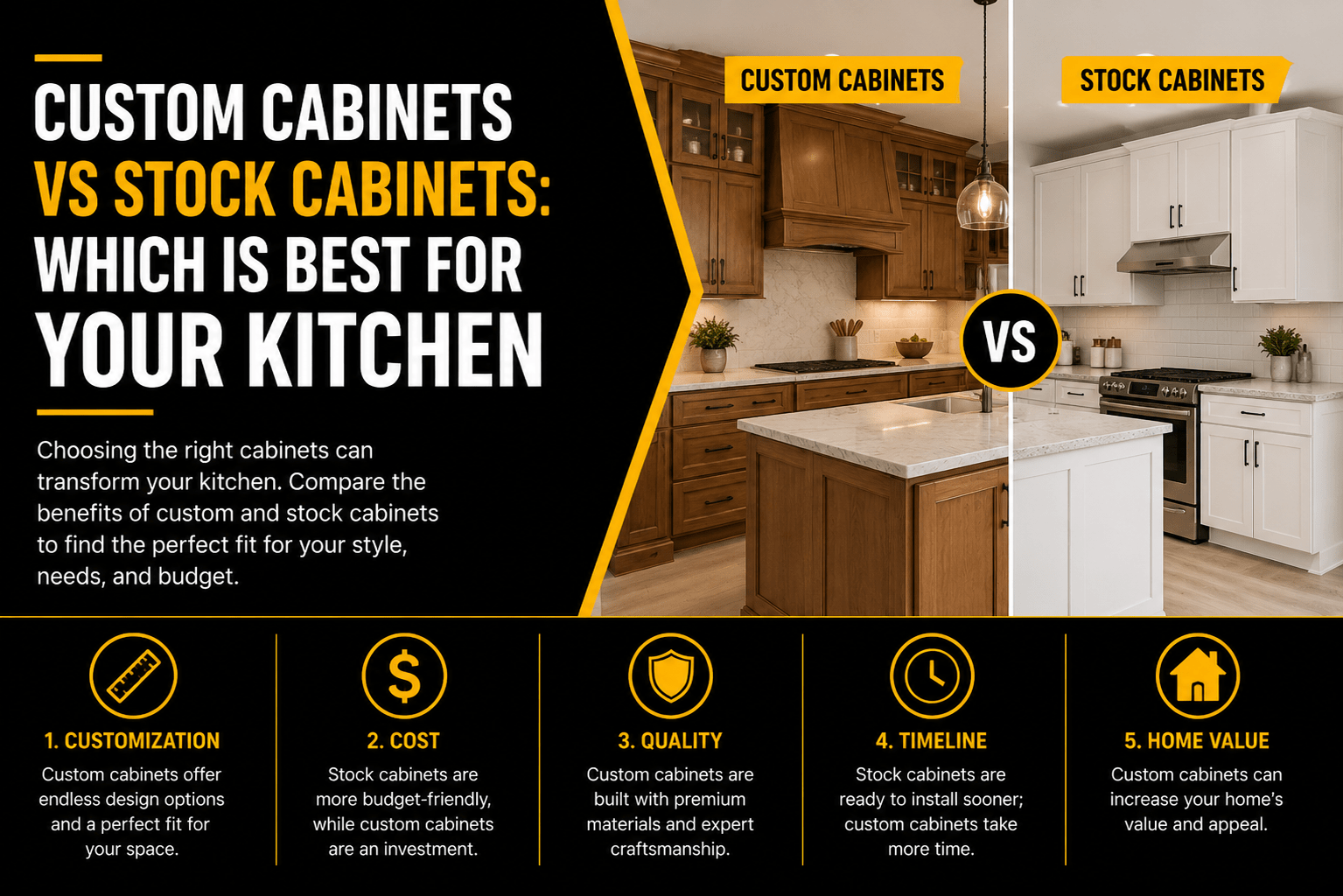
When it comes to a kitchen renovation, one decision tends to quietly consume more of your budget, timeline, and mental energy than almost anything else: cabinets vs stock cabinets. Specifically, whether to go with fully made-to-order cabinetry or lean on ready-made cabinets pulled straight off the shelf. It sounds like a simple cost-versus-quality trade-off, but the reality is far more layered than most homeowners realize until they’re already mid-project and regretting a choice made without enough information.
Whether you’re working with a tight budget, a non-standard kitchen layout, or a very specific design vision, the cabinet type you choose will shape everything: from storage efficiency to resale value to how long the installation process actually takes. This guide walks you through the honest, unfiltered breakdown of both options so you can make a decision that serves your home, your family, and your finances, and know exactly when you need a professional contractor in your corner.
What Are Stock Cabinets? Understanding Ready-Made Cabinets
Stock cabinets, sometimes called ready-made cabinets or pre-manufactured cabinets, are mass-produced in fixed sizes and finishes at factories, then shipped to home improvement stores, big-box retailers, or direct distributors. You walk in, pick a size that works close enough to your space, and take them home.
The appeal is obvious: they’re affordable kitchen cabinets by design. Because they’re produced at scale, manufacturers keep costs low. Cabinet sizing options are limited, typically in 3-inch width increments, and the available cabinet finishes and colors tend to hover around neutral, broadly-popular choices like white shaker, espresso, or basic oak.
- Cost: Generally range from $60 to $200 per linear foot installed, which is significantly lower than custom alternatives.
- Availability: Usually in stock and ready for same-day or next-day pickup, a major advantage when timelines are tight.
- Material quality: Typically constructed from particleboard or MDF with a veneer or thermofoil finish. Some higher-end stock lines use plywood boxes, but this is the exception.
- Sizing limitations: Fixed width increments mean gaps are common, often filled with filler strips, which can look awkward if not handled well.
- Cabinet hardware selection: Limited to what’s already installed, though buyers can often swap pulls and knobs themselves.
Stock kitchen cabinets work well for straightforward, standard-dimension kitchens where the goal is functional cabinetry at a controlled cost. However, the moment your kitchen deviates from standard, such as an angled wall, a unique ceiling height, or a diagonal layout, stock cabinets start creating problems that can cost more to work around than upgrading would have.
For a closer look at the broader decisions involved in a kitchen project, common kitchen remodeling mistakes covers the traps homeowners fall into when they don’t plan cabinet choices carefully enough from the start.
What Are Custom Kitchen Cabinets? The Made-to-Order Cabinetry Difference
Custom kitchen cabinets are built to order, typically by a skilled cabinet maker or a high-end manufacturer, to fit your exact kitchen dimensions, your specific aesthetic preferences, and your particular storage needs. Nothing is pulled off a shelf. Every cabinet is engineered for your space.
High-end custom cabinets offer a completely different experience in terms of cabinetry craftsmanship. You choose the wood species, the door style, the finish type, the interior configuration, the depth, the height, and even the drawer box construction. That level of cabinet customization is what separates a truly elevated kitchen from one that merely looks decent in photos but feels generic in real life.
- Cost: Typically ranges from $500 to $1,200+ per linear foot installed, depending on the materials and complexity.
- Lead time: Custom cabinetry takes 6 to 12 weeks to manufacture, so planning well ahead is essential.
- Material quality: Almost always solid wood or high-grade plywood construction with dovetail drawer joints, soft-close hardware, and full-extension slides as standard.
- Fit: Perfectly sized to your kitchen with no filler strips, no awkward gaps, and no wasted corner space.
- Longevity and cabinet durability: Built to last 20 to 30+ years with proper care. The cabinet quality differences between stock and custom are most evident here.
- Design freedom: Any finish, any wood type, any configuration, whether painted, stained, glazed, or natural.
Modern kitchen design approaches increasingly rely on custom cabinetry because it allows designers and contractors to treat the kitchen as a cohesive, purpose-built space rather than a collection of off-the-shelf parts stitched together.
According to Wikipedia’s article on kitchen cabinets, the development of cabinetry standards in the 20th century was driven largely by mass production, which are the same forces behind today’s stock cabinet market, but custom cabinetry has roots stretching back to traditional joinery craftsmanship that prioritized durability and tailored fit above all else.
Semi-Custom Cabinets: The Middle Ground Worth Knowing About
There is a third category in the kitchen cabinet comparison conversation that often gets underrepresented: semi-custom cabinets. These are factory-built cabinets, similar to stock cabinets, but with a broader range of sizing increments, more finish options, and greater flexibility in interior accessories and door styles. For homeowners planning a kitchen renovation in Flower Mound TX, semi-custom cabinets offer an ideal balance between affordability and personalization, allowing you to achieve a customized look without the higher cost and longer lead times associated with fully custom cabinetry.
Semi-custom cabinets typically run between $150 and $650 per linear foot installed. They are a smart middle path for homeowners who want more than stock can offer but are not ready for the full investment of true custom cabinetry. You still get real wood options, more cabinet sizing flexibility, and a wider range of cabinet finishes and colors than big-box stock lines, but with shorter lead times than fully made-to-order cabinetry.
The catch? Semi-custom cabinets still have manufacturer limitations. You can personalize within their catalog, but you can’t go beyond it. For a kitchen with genuinely non-standard proportions, or for a homeowner who wants a truly one-of-a-kind result, semi-custom often falls short of expectation.
Cabinet Types Side-by-Side: The Full Kitchen Cabinet Comparison
Here’s how stock cabinets, semi-custom cabinets, and custom kitchen cabinets actually compare across the factors that matter most to homeowners planning a kitchen renovation:
Cost and Budget
- Stock: Most affordable upfront, but hidden costs from filler strips, modifications, and lower longevity add up fast.
- Semi-Custom: Mid-range investment with better long-term value than stock.
- Custom: Highest upfront cost, but the best long-term return, especially for resale value and kitchen layout requirements that demand precision fit.
If budget planning is a concern, reviewing your home remodeling budget before committing to a cabinet type can prevent costly mid-project pivots.
Quality and Durability
- Stock: Particleboard or MDF construction, often with stapled joints. Cabinet durability is the weakest of the three options, typically showing signs of wear within 10 to 15 years.
- Semi-Custom: Better build quality, often with plywood boxes and stronger joinery than basic stock.
- Custom: Solid wood cabinet construction, dovetail joints, full-extension drawers, and superior cabinet hardware selection, all designed to outlast the home’s other renovations.
Fit and Kitchen Layout Requirements
- Stock: Fixed-size modules that work in standard kitchens. Non-standard layouts create gaps that require cosmetic workarounds.
- Semi-Custom: More sizing flexibility, but still constrained by manufacturer catalogs.
- Custom: Built to exact dimensions, making it ideal for angled kitchens, galley layouts, open-concept spaces, or any kitchen with unusual proportions.
Design and Aesthetics
- Stock: A limited palette of popular styles. Works for neutral, conventional kitchens.
- Semi-Custom: More styles, more finishes, more hardware options, but still manufacturer-constrained.
- Custom: Unlimited design freedom. Any wood species, any stain, any finish from shaker to inset to slab, all crafted to your exact vision.
Timeline
- Stock: Available immediately, making it great for urgent projects.
- Semi-Custom: 4 to 8 weeks lead time.
- Custom: 6 to 16 weeks lead time, which requires advance planning as part of your pre-remodel inspection and planning process.
DIY Cabinet Installation: What Homeowners Actually Attempt
There’s no shortage of YouTube tutorials and home improvement forum posts convinced that cabinet installation is a weekend project for any reasonably handy homeowner. And in the most forgiving of scenarios, a small kitchen, stock cabinets, perfectly flat walls, standard ceiling height, and a square room, a competent DIYer can pull it off with careful planning.
The typical DIY cabinet installation process looks something like this:
- Mark the wall studs and establish a level reference line around the perimeter of the kitchen.
- Install upper cabinets first, securing them to wall studs through the nailer rail inside the cabinet box.
- Set base cabinets, shimming as needed on uneven floors.
- Install filler pieces in gaps between cabinets or between cabinets and walls.
- Attach doors, adjust hinges, install drawer fronts, and add hardware.
- Install countertops, which typically requires a separate contractor anyway.
For stock kitchen cabinets in a clean, square kitchen, this is feasible. For semi-custom or custom cabinets with more complex configurations, the same process requires a significantly higher skill level and specialized tools.
Why DIY Cabinet Installation Fails More Often Than You Would Think
This is where the honest conversation gets important. The majority of DIY cabinet installations, even when technically completed, result in one or more of these outcomes that require professional correction:
1. Walls Are Rarely Square or Plumb
Nearly every residential kitchen has walls that are out of plumb, out of square, or both. A professional installer accounts for this during measurement and installation. A DIYer who doesn’t understand how to read and compensate for these variances ends up with cabinets that aren’t level, doors that don’t close properly, and gaps that can’t be hidden without significant remediation work.
2. Incorrect Stud Location and Fastening
Cabinets, especially upper wall cabinets, carry serious weight once loaded with dishes, cookware, and appliances. Missing a stud when fastening upper cabinets is a genuine safety hazard. Improperly anchored cabinets can fail without warning, especially when holding cast iron cookware or heavy appliance storage.
3. Measurement Errors in Cabinetry Planning
Cabinet sizing options don’t tolerate approximation. A measurement error of even a quarter inch in the wrong direction can make a cabinet run fail to fit the space. With custom or semi-custom cabinetry, those cabinets are already manufactured and there is no easy fix. This is one of the most expensive DIY errors in kitchen renovation planning because it often requires re-ordering specific pieces with significant lead time and additional cost.
4. Inability to Handle Plumbing and Electrical Conflicts
Kitchen layouts frequently require routing around existing plumbing supply lines, drain pipes, electrical circuits, and gas lines. A professional contractor, and specifically a licensed kitchen renovation team like those at Space Construction Inc’s kitchen renovation services, understands how to plan cabinet layouts around these constraints and coordinate with licensed tradespeople when modifications are needed.
5. Upper Cabinet Alignment Failures
Upper cabinets must align perfectly, both front-to-front and top-to-top, across an entire kitchen run. Achieving this requires a precisely established level line, proper use of a temporary ledger board, and the ability to hold cabinets in position while simultaneously driving fasteners. This is difficult to do alone and nearly impossible to do correctly without experience.
6. Finishing and Touch-Up Work
The visible quality of a cabinet installation lives in its finishing details: scribe moldings, crown molding at the top, toe kick installation, interior lighting integration, and the precise fitting of any custom panels on refrigerator surrounds or dishwasher sides. These finishing elements are where the craftsmanship either shines or exposes inexperience.
Homeowners who’ve navigated these challenges often share their experiences in threads like this DIY discussion on solo kitchen cabinet installation, where the consensus is clear: the planning and prep work is harder than the installation itself, and professional help is the right call for anything beyond a very basic layout.
Signs That Professional Cabinet Installation Is the Right Call
There are specific situations where professional cabinet installation is not just recommended, it is the only approach that protects your investment and your home. Watch for these signals:
- Your kitchen is not a simple rectangle. Angled walls, soffits, beams, or irregular ceiling heights require custom fitting that goes beyond what DIY accommodates safely.
- You’re choosing custom or semi-custom cabinets. The higher the cabinet investment, the more important it is to install correctly the first time. Mistakes with expensive cabinetry are not inexpensive to fix.
- Your kitchen requires plumbing or electrical relocations. Any time you’re moving a sink, dishwasher, or appliance location, a licensed contractor must be involved. Cabinet planning does not happen independently of those trades.
- You’re adding a kitchen island. Island cabinetry requires precise floor-level installation, coordination with countertop fabricators, and often seismic or structural anchoring depending on your local building codes.
- You want the work done once, correctly. The cost of correcting a failed DIY cabinet installation often exceeds what professional installation would have cost from the start.
- The kitchen is the primary reason you’re selling or refinancing. Buyers and appraisers are not fooled by cabinet installations that look off. A professionally installed, well-chosen cabinet type adds measurable value to a home.
- You’re dealing with an older home. Homes built before 1980 frequently have walls that are dramatically out of plumb due to settling, prior renovations, or original construction tolerances. Professional assessment is critical before any kitchen renovation begins.
Community discussions on platforms like this thread comparing custom vs stock cabinets consistently show that homeowners who hired professionals for their cabinet installation reported higher satisfaction, fewer callbacks, and better long-term outcomes than those who attempted the project without professional support.
Cabinet Buying Guide: Choosing the Right Option for Your Remodel
This cabinet buying guide breaks down which option makes the most sense based on your specific situation, because there is no single right answer for every homeowner.
Choose Stock Kitchen Cabinets If:
- Your kitchen is standard-dimensioned and rectangular with no irregular angles or unusual ceiling heights.
- Your budget for cabinetry is under $8,000 to $12,000 total and you cannot flex upward.
- You’re doing a rental property renovation where longevity and aesthetics are secondary to cost control.
- Your timeline is urgent and a remodel needs to be completed within weeks, not months.
- You’re doing a minor refresh, not a full gut renovation.
Choose Semi-Custom Cabinets If:
- Your kitchen has some non-standard dimensions that stock cabinets can’t cleanly address.
- You want more design choices than stock offers but are not ready for the full custom price tag.
- You’re balancing a moderate budget with genuine quality and aesthetic goals.
- You want real wood construction and better long-term cabinet durability without going fully bespoke.
Choose Custom Kitchen Cabinets If:
- Your kitchen layout is anything but standard, such as an L-shape, U-shape, or galley with unusual proportions.
- You’re doing a high-value renovation and resale value matters to you.
- You have a specific design vision that requires exact cabinet finishes, configurations, and wood cabinet construction details.
- You’re investing in a forever home and want cabinetry that reflects the quality of the rest of the renovation.
- You want maximum storage efficiency through built-in pull-out shelves, corner solutions, appliance garages, and custom drawer organization that only made-to-order cabinetry can provide.
If you’re still unsure where your project lands, reviewing how long kitchen projects typically take is a helpful framing exercise. Read our guide on how long kitchen renovations take to understand the real timeline implications of each cabinet type decision.
What Professional Cabinet Installation Looks Like with Space Construction Inc
When you work with a full-service contractor like Space Construction Inc for your kitchen renovation, cabinet selection and installation is not an isolated transaction. It is an integrated part of your overall kitchen renovation planning process.
Here’s what that actually looks like from start to finish:
- Pre-construction measurement and space assessment: Every dimension of your kitchen is precisely measured, including not just the width and length but also wall plumb, ceiling height variations, existing utility rough-in locations, and appliance placement. This data directly informs which cabinet type and configuration will work best.
- Cabinet layout design: Using your measurements and your goals, whether that is maximum storage efficiency, open-concept flow, or a specific visual design, the team develops a cabinet layout that makes the most of your space.
- Material and finish selection: For stock cabinets, the team sources from quality manufacturers. For custom or semi-custom, they work with trusted cabinet makers who meet the craftsmanship standards Space Construction Inc maintains across all projects.
- Coordinated installation: Cabinet installation is coordinated with countertop fabrication, backsplash work, lighting installation, and appliance placement so nothing moves forward in isolation and creates downstream problems.
- Finish and punch-out: Every cabinet run is checked for level, alignment, door adjustment, and drawer operation before the project is considered complete.
This level of integration, where cabinets are treated as part of a whole kitchen renovation rather than a standalone purchase, is what separates a contractor-managed kitchen remodel from a DIY piecemeal approach that leaves you managing multiple vendors, deliveries, and conflicts on your own.
Space Construction Inc provides kitchen renovation services across the Dallas-Fort Worth area, including Dallas, Frisco, McKinney, Plano, and Flower Mound, with expertise handling every cabinet type and kitchen layout scenario the region’s diverse housing stock presents.
Why Homeowners in DFW Trust Space Construction Inc for Kitchen Cabinetry
There’s no shortage of contractors and big-box installation services competing for kitchen renovation projects in the Dallas-Fort Worth market. What separates Space Construction Inc is a combination of craftsmanship accountability, integrated project management, and a track record of delivering kitchens that homeowners didn’t just like, but are genuinely proud of.
- End-to-end renovation management: Space Construction Inc doesn’t just install cabinets. They manage the full kitchen renovation, ensuring every trade works in sequence and every decision is coordinated. This is what prevents the scheduling conflicts, material delays, and costly rework that plague self-managed kitchen projects.
- Deep experience with all cabinet types: Whether the job calls for budget-conscious stock cabinets installed with precision, semi-custom configurations that stretch a moderate budget, or full custom cabinetry with complex built-in features, the team has handled it. There’s no learning curve on your project.
- Transparent pricing and honest timelines: No homeowner should be surprised by what their kitchen renovation costs or how long it takes. Space Construction Inc provides detailed estimates and milestone-based project schedules before work begins.
- Licensed, insured, and code-compliant work: Every installation meets local building code requirements for the DFW area critical for both safety and resale. Work that doesn’t meet code creates liability issues for homeowners that can surface at the worst possible time.
- Local knowledge of DFW housing: From post-war ranch homes in Grand Prairie to newer construction in Allen and McKinney, the team understands the structural quirks, ceiling heights, and layout challenges common to homes across the DFW region and they plan for them proactively.
- Post-installation support: A completed kitchen isn’t the end of the relationship. Space Construction Inc stands behind their work and addresses any cabinet door adjustments, hardware issues, or warranty-related follow-up without friction.
Choosing the right contractor is every bit as important as choosing the right cabinet type. Our guide on choosing a kitchen remodeling contractor walks through exactly what to look for and what red flags to avoid before signing any contract.
Frequently Asked Questions: Custom Cabinets vs Stock Cabinets
How much more do custom cabinets cost compared to stock cabinets?
Custom cabinets typically cost $500 to $1,200+ per linear foot installed, compared to $60 to $200 for stock cabinets. The price difference reflects material quality, cabinetry craftsmanship, and the precision of made-to-order sizing. However, custom cabinets last significantly longer and often eliminate the costly workarounds that stock cabinets require in non-standard kitchens.
Are stock kitchen cabinets good quality?
Stock kitchen cabinets vary widely in quality by brand and price point. Entry-level stock cabinets use particleboard and stapled joints adequate for light use but not built for decades of daily kitchen demands. Mid-to-upper-tier stock lines use plywood boxes and better joinery, offering reasonable cabinet durability for the price when properly installed.
What is the difference between semi-custom and custom cabinets?
Semi-custom cabinets are factory-built with more sizing flexibility and finish options than stock, but they still operate within a manufacturer’s catalog. True custom cabinets are built entirely to your specifications any size, any wood species, any configuration. Custom offers complete design freedom; semi-custom offers expanded choice within structured limits.
How long does it take to get custom kitchen cabinets made?
Lead times for custom kitchen cabinets typically range from 6 to 16 weeks depending on the manufacturer and project complexity. This is why kitchen renovation planning needs to start well before your desired project start date. Semi-custom cabinets usually run 4 to 8 weeks; stock cabinets are available immediately or within days.
Can I install cabinets myself to save money?
DIY cabinet installation is feasible for very simple, standard-dimension kitchens with stock cabinets. However, most kitchens have walls that aren’t perfectly plumb, require coordination with plumbing and electrical, or involve layout complexities that make professional installation the safer and more cost-effective choice especially when the cabinet investment is significant.
Do custom cabinets add value to a home?
Yes custom cabinets consistently contribute to higher kitchen appraisal values and stronger buyer appeal during resale. The precision fit, superior cabinet durability, and elevated aesthetics that custom cabinetry provides signal quality to buyers and appraisers alike. In competitive DFW markets, the kitchen is often the room that closes the sale or kills it.
What cabinet type is best for a small kitchen?
Small kitchens benefit most from custom or semi-custom cabinets because storage efficiency is critical in tight spaces. Custom cabinet configurations built-in pull-outs, corner optimization, full-height pantry towers maximize every inch. Stock cabinets in small kitchens often leave awkward gaps and miss opportunities to maximize vertical and corner storage.
Ready to Plan Your Kitchen Cabinet Project? Let’s Talk.
The choice between cabinets vs stock cabinets ultimately comes down to your kitchen’s dimensions, your design goals, your timeline, and the investment level that makes sense for where you are in your homeownership journey. What doesn’t change regardless of which direction you go: the quality of the installation determines whether your cabinets perform the way they’re supposed to for the next decade or two.
At Space Construction Inc, we’ve managed kitchen renovations across the full spectrum from straightforward stock cabinet installations in rental properties to fully custom cabinetry in high-end primary residences. We bring the same level of attention and accountability to every project because we know that for the homeowner, it’s never a small job.
If you’re in Dallas, Plano, Frisco, McKinney, Flower Mound, Denton, or anywhere across the DFW area, we’re ready to walk through your kitchen with you, give you an honest assessment of what your space needs, and build a plan that fits your goals and your budget.
Get your free kitchen renovation estimate today no pressure, no obligation, just a real conversation with an experienced contractor who knows how to get kitchens right.
Final Thoughts: Making the Right Cabinet Decision for Your Kitchen
The debate between custom cabinets vs stock cabinets doesn’t have a single winner it has context. Stock cabinets are a legitimate choice when the conditions are right. Custom cabinetry is the right investment when quality, precision fit, and long-term durability matter. Semi-custom cabinets earn their place squarely in between.
What matters most is that you make this decision with the full picture not just the sticker price on the cabinet box, but the total cost of ownership, the installation quality required, the limitations your kitchen layout will impose, and the long-term value you want to walk away with. Rushing into a stock cabinet purchase to save a few thousand dollars upfront only to spend more money fixing installation problems or replacing worn-out cabinets in 10 years isn’t the smart financial move it looks like on paper.
Work with professionals who understand the full scope of kitchen renovation planning. Make your cabinet choice based on real information, real measurements, and a real plan. That’s what Space Construction Inc provides and it’s the approach that produces kitchens homeowners are genuinely happy with, year after year.
Contact Space Construction Inc today and take the first step toward the kitchen your home deserves.

Space Construction is a premier Dallas construction company specializing in home remodeling, commercial construction, home additions, kitchen and bathroom renovations, custom builds, and restoration services. Our expert team is dedicated to delivering high-quality craftsmanship, timely project completion, and exceptional customer satisfaction. Whether you need a full remodel, room addition, or commercial build-out, Space Construction provides reliable, professional solutions customized to your vision. Contact us today for a free consultation and let us bring your construction project to life!
0 Comments